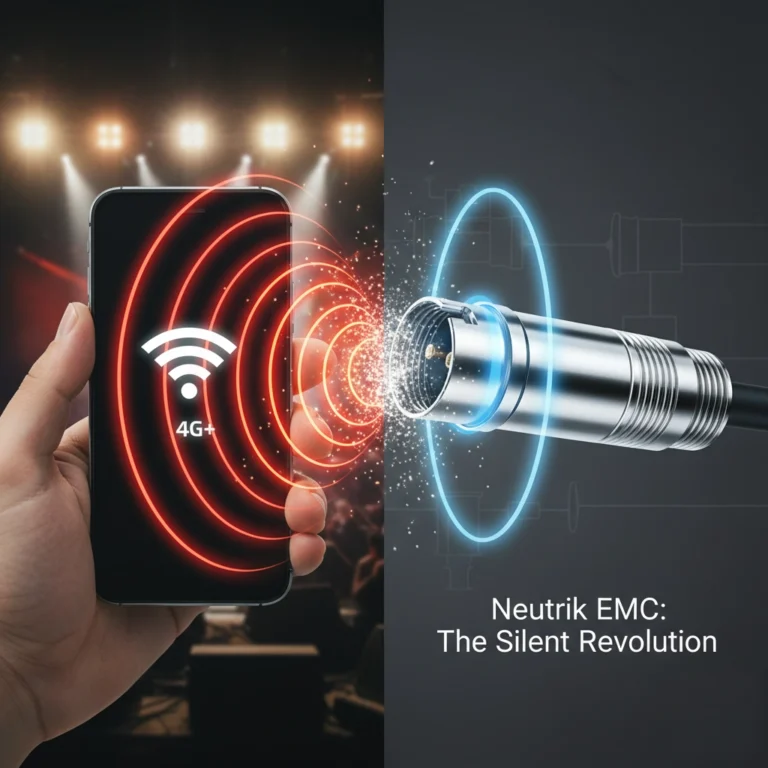
Tired of the annoying “buzz” from mobile phones in your speakers or strange noises in your headphones during a recording session? The problem might not be a “cheap cable,” but rather how that cable interfaces with your equipment. Let’s dive into why Neutrik created the EMC-XLR series and why it’s a must-have for the modern stage and studio.
What is the problem with standard cables?
In a classic XLR cable, the shield protects the signal wires from interference, but it is typically connected only to Pin 1 (Audio Ground). This essentially turns the cable into an antenna: it picks up Wi-Fi and GSM signals and “injects” them directly into the audio path.
If you try to solve this by hard-wiring the connector shell to the shield, you often create a ground loop — that dreaded 50/60 Hz hum that drives sound engineers crazy.
The Secret Weapon: The EMC Series
Neutrik solved this dilemma by integrating two simple yet brilliant components inside the connector:
- Annular Capacitor: This connects the cable shield to the metal chassis of the device. For radio frequency (RF) interference (MHz/GHz), the capacitor acts as a short circuit—the interference simply “drains” onto the device housing and disappears. However, for 50/60 Hz hum, it remains an insulator. No ground loops!
- Ferrite Bead: A small black “bead” on Pin 1. It acts as a low-pass filter, blocking any remaining high-frequency “trash” from entering the audio circuit.
How to Assemble This Cable Correctly?
Buying a premium connector isn’t enough—you have to assemble it right. The biggest mistake is soldering it like a standard XLR.
- Forget the Jumpers: There is no need to manually bridge Pin 1 to the shell.
- Use the Clamp: The cable shield must be folded back and tightly clamped by the special circular ring inside the connector. This mechanical contact is what sends the interference to the capacitor.
- Both Ends: For maximum protection, install EMC connectors on both ends of the cable. One connector is only half a shield.
Summary
The EMC-XLR series transforms your cable from a passive conductor into an active filtration system. It is the ideal solution for venues packed with wireless systems, Wi-Fi routers, and mobile phones in every audience member’s pocket.
Comparison: Standard XLR vs. Neutrik EMC
| Feature | Standard XLR (XX Series) | Neutrik EMC-XLR |
| RF Interference Protection | Basic (cable shield only) | Maximum (Capacitor + Ferrite) |
| Mobile Phone Reaction | Possible clicks and “buzzing” | Complete suppression of noise |
| Ground Loops (50/60Hz) | Occur when shells are bridged | Eliminated (via capacitive decoupling) |
| Chassis Ground Contact | Single point (Pin 1) | 360° contact (via ground spring) |
| Application | General purpose | Live shows, TV studios, critical recording |
Looking for Reliable Connectivity?
Don’t let interference ruin your sound. We offer a wide range of genuine Neutrik connectors, including the specialized EMC series, and professional cables to match: Browse Neutrik Connectors Catalog →